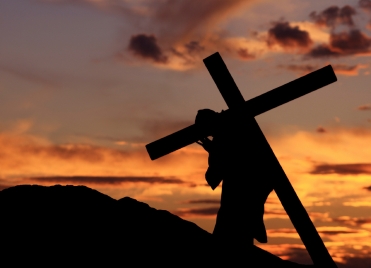
Apostolic authority and Succession

When we discuss Apostolic Succession, and the authority granted not only to Jesus’ Apostles, as well as to those who would come after them, it is crucial to our understanding to look upon this with a keen eye toward context. The biblical content, and indeed the very phrasing that our Lord used was predicated on the knowledge of the audience being addressed, and the accommodations of speech made factoring in the common knowledge and customs of the time. We need to remember the letters, or ”small books” that comprise the bible, since that is what the word bible actually means, were written by men who were steeped in the knowledge of the Jewish faith and customs they grew up with. This includes also the words of Jesus himself. He did not find it necessary to delve into what would have been considered to be both redundant, and superfluous commentary since his audience, both Jew and likely gentile would likely have been aware of the practical assumptions made in conversation and interactions based on pervasive social and cultural norms.

With all this said, when Jesus commissioned the twelve, to go out and to heal, and forgive sins, and to drive out demons (John 20:21-23), this would have been seen as the acts of those to whom authority had been granted. This is also true of how those twelve were addressed in closed and intimate conversation. Jesus had many disciples, which simply means students, but he only had the twelve Apostles, which denotes someone who has been given a mission. In particular, when Jesus told Simon Peter that upon him, as the rock which his new name denoted, he would build His Church (Matthew 16:18-19), this would have been viewed as a unique and significant role of leadership within His Church, from the viewpoint of the people and the other Apostles.

These roles would also have been seen by the people as enduring. Just as the Levitical priestly roles were passed down, it would have been assumed that men would eventually die, and that they would have successors appointed who would carry on the same work (Acts 1:20-26, 2 Timothy 2:2, Titus 1:5, 1 Timothy 3:1-7), and with the same granted authority passed on by conveyance of the Spirit through imposition of hands and anointing. Jesus himself said plainly that no one knew the time of place when all things would come to fulfillment, not even the Son, only the Father, so he certainly would have taken into account the likely necessity of the roles of the Apostles continuing through an undefined period of time.

Jesus also was very deliberate in choosing his audience for certain discussions. He did not grant the people full knowledge of the parables that He spoke. He did not create a common authority to forgive sins, or heal, or drive out demonic influence. Nor did he publicly proclaim to the people to perform the breaking of the bread or the offering of the cup, these instructions to fully understand and do these things were given only to his Apostles, something that would  have spoken clearly in terms of His intent to anyone of the time. Additionally, the timing of the instructions that he gave pertaining to the celebration of the Eucharist in particular was certainly chosen with care, He gave this commission at the last meal He would share with his Apostles, which would have driven home the paramount nature of His instructions and by whom they would be carried out.

Like so many things as we read through scripture, it is both inaccurate and imprecise to try to understand its content without due deference to contextual influence. This make it all the more critical that as we try to understand the intentions of our Lords teachings, we do not get allow ourselves to fall into bad practice and assume that the translated words can be viewed without cultural and social understanding. It is equally important to look at not only the translated text, but also the accounts in the original language in which it was recorded, and factor this into our understanding.    
Why do we need to go to a Priest for Confession?

The idea of confessing one’s sins to a Catholic Priest may seem a bit odd to those who were not brought up in the Catholic teaching (and even to some who were), and so I am sometimes asked about why this is necessary. Why can’t I simply confess my sins to God? The short answer to the last question is, you can, and should confess your sins directly to God, and do so with complete repentance in your heart. This is ALWAYS part of the process of seeking God’s forgiveness and mercy. However, that is only part of the equation in the Catholic teaching. Before I go to much farther, I want to clarify something, the word Catholic simply means universal, the Catholic Church was not a denomination that emerged after the Protestant reformation which required defining. The Universal Church had always existed since the time of Christ, and it draws many of its traditions and teachings from those that would have been observed by Jesus and the rest of the Jewish people of that day, and well before. The confessing of one’s sins is one of those areas rooted in this, but also very much in the New Testament, and is directly rooted in the mission that Jesus Christ gave his disciples.

First, let’s talk about the ancient tradition of confessing one’s sins. The Levitical Priests of the time followed what was present in several of the Old Testament scriptures, and specifically the book of Leviticus, in Leviticus 19:20-22 a good example is provided (see below).

“With the ram of the reparation offering the priest shall make atonement before the Lord for the wrong the man has committed, so that he will be forgiven for the wrong he has committed.”

The Levitical Priest is called upon to make atonement for the sins committed, and as part of that is acting as an intercessor so that the sin will be forgiven. This is the root of that tradition in the Old Testament, and it is one that would have been followed in Jesus’ time.

Jesus, however, was a game changer on many levels, and one of them is how we can be healed of our sins. Remember, in Leviticus, the word atonement is used as the action that the Priest provides in the equation. Jesus on the other hand is able to forgive sins, and so directly heal those who are afflicted by sin. He saw this as a much higher priority than the physical healings He performed, and yet He also often paired the two together. In the narrative of the paralytic lowered down to him through the roof (Mathew 9:1-8), the first thing He says is that the man’s sins are forgiven, then and only then, does he heal him physically. Yet he also tells them in many instances to sin no more, such as the healing of the man lying ill by the pool of Bethesda, or the woman caught in the act of adultery.

 John 5:14-15

“Look, you are well; do not sin anymore, so that nothing worse may happen to you.”

John 8:1-11

” Then Jesus said, “Neither do I condemn you. Go, [and] from now on do not sin anymore.”[1]

Sin in that time was seen as directly linked to one’s overall condition, and this has not changed when we consider the complete person. For this reason, Jesus knew that the people would need to be able to receive forgiveness and healing on a continuing basis, and He also knew that as part of that they would need to be counseled to sin no more and instructed on how to avoid sin in the future. To accomplish this, He commissioned His Disciples to forgive sins and heal the people from the corruption that comes from it. In John’s Gospel we hear the narrative of the commissioning of the Disciples, those who were the forerunners of the Priests and Bishops of today.

John 20:21-23

“Peace be with you. As the Father has sent me, so I send you.” 22 And when he had said this, he breathed on them and said to them, “Receive the holy Spirit. 23 n Whose sins you forgive are forgiven them, and whose sins you retain are retained.” [2]

This was the New Testament root of the practice of having one’s sins heard and forgiven through the intercession of a Priest. Jesus had a purpose with every word that He spoke, and this is certainly no exception. He knew that the people would need to continue to be guided and held accountable for their conduct, because He knew only too well human nature, and that His creations would require this to be sound in spirit and body. This is the essence of the healing that takes place in the confessional, the priest is not there to simply listen to us confess the wrongs we have done, he is not there to judge, he is there to allow Jesus to work through him, just as he worked through His disciples to provide forgiveness through administering Absolution in the name of Jesus Christ, and healing to the people. To council the people to sin no more and to provide insight into how to avoid the same mistakes in the future, all of this is part of that healing and forgiveness that takes place through interactions with the Priest. When we are forgiven, by definition we are truly penitent of our actions because we know the wrong, we committed, and should be determined to try to avoid sin in the future, just as our Lord warned so that we would not continue to be afflicted by sin. This does not usually happen on its own but comes from intervention to help change behaviors. This comes about through the continued work of His disciples who have the commission from Him to pursue this ministry.

The ministry of helping others through the forgiveness of sins is received through the imposition of hands and the reception of the Holy Spirit that occurs at ordination and is completely centric to the ordained priesthood. This is not to be confused with the common priesthood which calls all of us to spread Gods word but is the unique extension of those specifically chosen by Jesus Christ to go forth with the mission of forgiving the sins of the people. He chose the Twelve specifically for this, not all men, and this specific mission through joining those chosen through apostolic succession continues to this day.

2 Corinthians 5:18-21

18 And all this is from God, who has reconciled us to himself through Christ and given us the ministry of reconciliation, 19 namely, God was reconciling the world to himself in Christ, not counting their trespasses against them and entrusting to us the message of reconciliation. 20 So we are ambassadors for Christ, as if God were appealing through us. We implore you on behalf of Christ, be reconciled to God. 21 For our sake He made Him to be sin who did not know sin, so that we might become the righteousness of God in him. [3]


The greatest help for anxiety and depression

There are a lot of you who may not know that anxiety is something I have dealt with for many years. It is something that I continue to struggle with at times, but that can be addressed in a way that might surprise you. You see, a big part of either anxiety or depression is despair that comes with either of them. Despair feeds off of our fears and worries and creates a downward spiral. This is something that we can combat with the help of God, who is far stronger than we are and desperately wants to help us. All that is asked, is for us to trust Him, and to allow Him to take on much of our burden. This can be harder than it sounds though and will require some practice, patience (on our part, He has that covered), and a small leap of faith. I can tell you though, that this absolutely will yield fruit if you give it a chance. If you are willing to give Him a chance.

What I am talking about specifically is a writing and prayer that was created by Father Don Dolindo Ruotolo, whose cause for canonization is being pursued. Father Ruotolo wrote much about the interpretation of scripture, but also about things that God inspired him to pursue that were designed to help us spiritually and even in our temporal life. Please read the writing below that I have quoted. You will not take in all the nuances by reading it only once, it may take several times, perhaps even a dozen, but as you relax and really allow this to speak to you, you will begin to see the places where the words that Father Ruotolo wrote by God’s inspiration will touch your particular situation. Read this with humility, and give it a chance. Whoever you are reading this, I hope you will find this helpful, and will give this a chance. God Bless You

“Jesus to the soul: Why are you upset and agitated? Leave your cares to Me and all will be fine. I tell you honestly, every act of true and blind reliance on Me, results in what you desire and will resolve all your difficulties. Abandonment in Me does not mean being frustrated, becoming anxious and desperate, offering Me your anxious prayer, that I may follow you and have your anxiety be a prayer. Abandonment means to shut the eyes of your soul in peace, moving your thoughts away from your troubles, and instead of thinking about your worries and pain, let Me take over your troubles. Simply say: Jesus, You take over. To be worried, restless, and to think of the consequences of an event is the opposite of reliance, it is really contrary to it. It is like a child, who wants his mom to take care his needs, but in the way he wants: and with his whims and childish ideas he hampers her work. Shut your eyes and go with the flow of My grace. Do not ponder over your present moment and put away thoughts of your future as a temptation; rest in Me, believe in My goodness and I swear on My Love, that if you think like this: Jesus, You take over, I indeed will do it for you, I will comfort you, free you, and guide you.

If I have to take you in a different direction from the one you are looking at, I will train you, I pick you up in my arms, and you will find yourself, like a baby sleeping in his mother’s arms, on the other shore. What gives you immense stress and hurts you, is your reasoning over it, your thoughts and the pains it gives you; it is wanting at all costs to take care by yourself of what is afflicting you. How many things I can do, be it a material or a spiritual need, when the soul turns to Me, looks at Me and says to Me: Jesus, You take over, and closes its eyes and rests in Me! You do not receive many graces because you insist on getting them by yourself; but instead you will receive numberless graces, when your prayer is in full reliance on Me. When you are in pain, and you pray that I may act, you want Me to act as you believe I should… you do not turn to Me; instead you want Me to submit to your ideas; you are like a sick person who does not ask the doctor for the cure, but tells him what the cure is to be. Don’t be like this, but pray as I taught you in the Our Father: Hallowed be your name, which means, may You be glorified in this need of mine; Your kingdom come, which means, everything may work toward Your Kingdom in us and in the world; Your will be done on earth as it is in heaven, which means, You direct it as it seems best to You for the good of our eternal and temporal life. When you truly tell me: Your will be done, which is the same then to say: Jesus, You take over, then I do intervene with all My omnipotence, and I will resolve every situation, even if there is no way out.

 For example, do you see your sickness becoming worse instead of improving? Don’t become anxious, close your eyes and tell Me with trust: Your will be done, Jesus, You take over. I repeat it, I do take care, I intervene like a doctor, and even do a miracle if it is necessary. Does a patient become worse? Don’t be frightened, close your eyes and say: Jesus, You take over. I tell you again: I will indeed do it for you, and there is no medicine more powerful than my loving intervention. I take over only when you close your eyes. You never sleep, you want to appraise everything, to think, to delve into everything; you choose to rely on human power, or, worse, on men, trusting their intervention. This is what hampers My words and My will. Oh how much I long for this reliance in order to assist you, and how much I grieve to see your anxiety. Satan does just this: he gives you anxiety to remove Me from you and throw you into human initiative. Trust only in Me instead, rest in Me, rely on Me in everything. I do miracles in proportion to your complete reliance on Me, with no thought of yourself. I spread treasures of graces when you are in the most squalid poverty. If you have your own resources, even a few, or if you seek them, you are at the natural level, thus you follow the natural way of things, which often are dominated by Satan. Never a thinker or a philosopher has done any miracle, not even among the Saints; only he who relies on God does divine work.

 When you see that things become complicated, say with your eyes closed: Jesus, I abandon myself to You; Jesus, You take over, and stop worrying about it, because your mind is sharp and for you it is difficult to distinguish evil; but trust in Me, and let your mind wander away from your thoughts. Do this for all your needs; all of you, do this, and you shall see great things, endless and silent miracles. I swear it on My Love. I shall indeed take over, you can be sure of it. Pray always with this loving confidence and you shall have great peace and great fruits, even when I choose for you the grace of immolating yourself for reparation and the love that entails suffering. Do you believe it is impossible? Shut your eyes and say with all your soul: Jesus, You take over. Don’t be afraid, I indeed will take care of you, and you shall bless My Name, in humility. A thousand prayers do not equal only one act of abandonment; don’t ever forget it. There is no better novena than this: Oh Jesus I abandon myself to You, Jesus, You take over.

Lastly, if you would like to ever speak to me about your struggles, and just talk, I would welcome the opportunity. I am a pretty good listener. No one needs to walk through this life alone, no matter what we are dealing with, that is not what was intended for us.

You can always reach me at this address – czlamal@gmail.com

Moving our faith to a secure foundation within

I think that most of us, at one time or another pray that our faith may be strengthened. Very often this is during a time of crisis or trial, and we are not at peace. At some level, we know that we are in God’s hands, every one of us, and yet we have doubts, and fears, and anxiety. Our enemy knows every one of our weaknesses intimately and will use these in a full onslaught designed to destroy our hope and to create doubt in what we know to be true so that it doesn’t always feel like we know it. This is his most powerful tactic because once our hope is compromised, we can feel separated from God, and we are therefore vulnerable. Our fears and emotions are used to override our reason and intellect, and the resulting chaos is ripe for evil to do its work.

There is a difference between what I will call emotional knowledge (things we casually believe, but which we allow to be subject to all of the range of emotions, including the negative ones because we don’t quite trust in them completely), and intellectual knowledge (these things we know to be true, based on experience, learning, and evidence which we see as relatively immutable). We are all subject to both of these forms of knowledge or belief, but our goal for those things that are truly important is to have them on the more concrete footing of intellectual knowledge. Now, I want to be careful here, I am not saying that all things can be explained, proven, or believed in solely through our human intellect. No, for the most important of our beliefs, there is also faith required. Faith, however, is not directly equatable to emotion (even though we will sometimes feel great emotion during our expression of our faith). Still, it is more than that, more than just strong feelings, it is a mix of knowledge passed on, the evidence we continue to accumulate throughout our lives, and then the humility and trust to allow room for those pieces of evidence that do not have the capacity to prove through conventional means. True faith and intellect are not at all at odds.

We know that as human beings our capacity to explain or test for evidence of things we cannot readily explain is rather limited. We also know that the evidence for God’s existence and loving interaction with humanity is frankly overwhelming, and yet our belief can be one of the first casualties in terms of trusting in His loving plan when we are truly pressed. We ask God to give us faith to get through these times, and we sometimes even chastise ourselves for not having sufficient faith to sustain us. What I think we miss (at least I know I have, and probably will continue to at times – I am a work in progress) is that our faith is in part predicated on trust, as well as grace. We know that we can have only limited trust in ourselves because our abilities are so finite. Anything we feel in terms of true control of our lives is largely an illusion. I actually believe we instinctually trust in God more than we realize or will admit to at a more conscious level, because to do that would require us to quantify that trust and stop being so intellectually lazy. I say that I believe in God, but if that is so, then why when the chips are down, do I worry so incessantly? I suspect that perhaps it’s because when all those negative emotions come flooding in, I have not done my intellectual due diligence to make my belief less vulnerable, in other words, moved them from emotional to intellectual intelligence.  Saint Padre Pio told us to “Pray, hope, and don’t worry. Worry is useless. God is merciful and will hear your prayers”. This is probably the best summation of what our life philosophy should be, but it is still easier said than done. The only way to shift our belief from emotional to intellectual knowledge is to gain intimacy with what we believe. With intimacy comes a secure foundation. The rooted knowledge we will hold to be true, no matter what life throws at us. A knowledge that we reflexively hold to be unshakeable at our very core. We gain this kind of intimacy through building a strong relationship, and through experience. We build our relationship through time spent in solitude and prayer, through receiving the Sacraments, and in communion with others who believe (our brothers and sisters in our family in Christ), and the experience can be gained through study and reflection of who God is through the written word and healthy discourse.

I have never been disappointed with any of my time spent learning about God – even when looking into the toughest of questions. One of the most amazing aspects of our faith is the solidity of its history and theology. True, there have been imperfect people involved in our history, but that is the human condition. God, however, is unchanging in what he wants for us. There is no such thing as a topic within our faith that cannot be discussed/explained, as much as our faculties will allow us. Nothing is off the table. There is no need to fear anything we might find. As we peel back the layers and learn more about who it is we want to place our faith in, the more we will gain in reasons to trust, and ultimately whom our faith is always secure in – our loving God.

Advent – A time to prepare

We’re coming up on the season of Advent, and I tend to get a bit more introspective this time of year. This year though, there were two very external events that got me more into that mode than usual. The first was this past Sundays first reading (33rd Sunday in ordinary time) from the prophet Daniel. He alerted us about the two fates that await each of us as the end of time   (see the passage below).

Many of those who sleep in the dust of the earth shall awake; some shall live forever, others shall be an everlasting horror and disgrace.

Daniel uses two key words in describing the fate of condemnation – horror and disgrace. Horror is analogous to fear, and this is one of the favorite tactics of the adversary. If we are afraid, we are diminished in our ability to deal with things, and often this can lead to hopelessness. This is exactly what Satan wants, to have us give up, and remain in a state of sin. Perceived disgrace is another tool that he favors, because it pairs with resentment, and a hardening of our hearts to whatever we feel we have been slighted or disgraced over, and our ability to forgive is damaged. All of these things keep us from spiritual healing and mending our relationship with God and with others. If we allow ourselves to be left in such a state, the situation is one of horrible self-fulfillment of the prophets warning.

We need to instead, embrace the opportunities this upcoming season of preparation affords us. We need to spend time in reflection, and self-examination of our relationships. We need to reach out and mend that which is broken. We need to go to confession and unburden ourselves of the load that has accumulated. Only then can we truly be part of the season of peace and fulfillment that we are anticipating when we celebrate Christs birth.

At Mass this past Sunday, there was a situation that frankly threw me for a loop at first. During the intercessory prayers one of our family at Saint Bernadette’s was praying very loudly and earnestly for forgiveness and for relief from the things that bound him. He eventually came before the altar and fell to his knees and cried before our Lord as be prayed. I didn’t know quite what to make of it for a moment, but then it hit me, out of all of us there, this man had the absolute right idea. He didn’t care who was watching, he didn’t care that this was out of the “norm” for our Sunday Mass ritual, he knew what he needed, and to whom he needed to present his petitions. It really moved me, and I suspect many of those around me. We should all feel so uninhibited in our pleas, because the only one that truly matters, is the One who sees all with no judgement about appearances, but only of what is really on the mind and heart.

An explanation about Communion, until we are all one faith

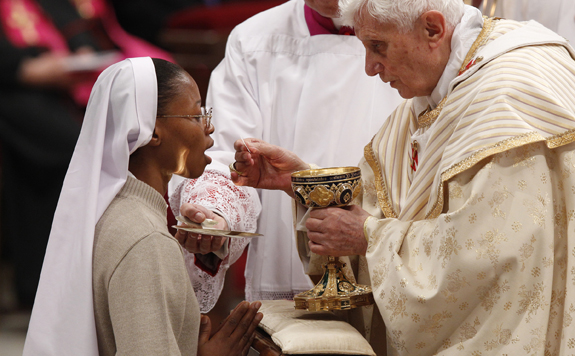
POPE DISTRIBUTES COMMUNION AS HE CELEBRATES CHRISTMAS EVE MASS IN ST. PETER'S BASILICA AT VATICAN

The highlight of my week happens each Sunday, when I am able to experience with my Church family the solemnity and joy that is the Eucharistic part of the liturgy. When I distribute Communion, I am awestruck by what I see in the faces of the people receiving. There is a joy and solemnness that I see nowhere else. Each person seems to grasp how close this encounter with Jesus Christ is, and the intimacy involved.

There is another side of this experience though, that is extremely painful to me as the cleric distributing Communion, and to the person who may not be able to receive it. I am not referring to when someone comes up to me with their arms crossed, perhaps because they have not had a chance to go to confession yet and must wait until next week. I am referring to the person who is perhaps unable to receive the Sacrament due to a more lasting circumstance. Yet even there, I see grace at work, they are at Mass, there is the desire to maintain their relationship with Jesus, even if Sacramentally there are some limitations. This pursuit of their relationship with God, and their persistence, will not go unrecognized.

There is one other circumstance that I sometimes encounter, and that can be painful, and often misunderstood. That is when someone who is not Catholic cannot receive Communion at Mass. This is very disheartening for someone who is used to receiving each Sunday, but when they come to visit our Church they cannot. This is a long lasting repercussion of the Reformation, that continues to divide us to this day. As Catholics we believe in Transubstantiation, which means we believe that the bread and the wine that is placed on the altar, are transformed during the Epiclesis of the Mass, into the actual body and blood of Jesus Christ. This happens mystically, but is based on the very clear statements that Jesus gave us at the last Supper (Matthew 26:26-28).

While they were eating, Jesus took bread, said the blessing, broke it, and giving it to his disciples said, “Take and eat; this is my body.”* k27Then he took a cup, gave thanks,* and gave it to them, saying, “Drink from it, all of you,28l for this is my blood of the covenant, which will be shed on behalf of many for the forgiveness of sins.

Notice the word covenant in the last line, this is not a word used at all lightly by the people, and certainly not by a prophet. The blood of the pascal sacrifice which saved us all, the blood of the Perfect Lamb Jesus, was not to be relegated to simple wine or a symbol. Moreover, if you read John 6:51-68)

I am the living bread that came down from heaven; whoever eats this bread will live forever; and the bread that I will give is my flesh for the life of the world.”a52The Jews quarreled among themselves, saying, “How can this man give us [his] flesh to eat?”53Jesus said to them, “Amen, amen, I say to you, unless you eat the flesh of the Son of Man and drink his blood, you do not have life within you.54Whoever eats* my flesh and drinks my blood has eternal life, and I will raise him on the last day.55For my flesh is true food, and my blood is true drink.56Whoever eats my flesh and drinks my blood remains in me and I in him.57Just as the living Father sent me and I have life because of the Father, so also the one who feeds on me will have life because of me.b58This is the bread that came down from heaven. Unlike your ancestors who ate and still died, whoever eats this bread will live forever.”59These things he said while teaching in the synagogue in Capernaum. 60Then many of his disciples who were listening said, “This saying is hard; who can accept it?”61Since Jesus knew that his disciples were murmuring about this, he said to them, “Does this shock you?62What if you were to see the Son of Man ascending to where he was before?*63It is the spirit that gives life, while the flesh* is of no avail. The words I have spoken to you are spirit and life.64But there are some of you who do not believe.” Jesus knew from the beginning the ones who would not believe and the one who would betray him.c65And he said, “For this reason I have told you that no one can come to me unless it is granted him by my Father.”66As a result of this, many [of] his disciples returned to their former way of life and no longer accompanied him.67Jesus then said to the Twelve, “Do you also want to leave?”68Simon Peter answered him, “Master, to whom shall we go? You have the words of eternal life.

Pay attention to the wording here, it is extremely clear from the standpoint of the language that our Lord uses, that this is not a parable – he is being very direct, and there is a direct purpose at work here. Jesus knows who will leave, and who will stay, despite His statements that for a Jew of that time period (remember the Jewish people were surrounded by pagan tribes that practiced blood sacrifice and cannibalism) would be extremely distressing and would appear to violate the law. This controversial address to those present left Him with the twelve, who would take His word on faith.  This distinction in belief is the core of why as Catholics we treat communion differently. We believe that if someone is receiving the true body and blood of Jesus Christ, there is a specific manner in which they must be prepared. Belief is obviously the first step, but there is more. In order to receive one must do so in a worthy manner (see 1 Corinthians 11:26-29)


For as often as you eat this bread and drink the cup, you proclaim the Lord’s death until He comes. 27 Therefore whoever eats the bread or drinks the cup of the Lord in an unworthy manner, shall be guilty of the body and the blood of the Lord. 28 But let a man examine himself, and so let him eat of the bread and drink of the cup. 29 For he who eats and drinks, eats and drinks judgment to himself, if he does not judge the body rightly.

For Catholics this means that if you have not been to confession and received absolution, you would be receiving the actual body and blood of our Lord (again due to transubstantiation) in an unworthy manner. We would not want to place someone in this position either intentionally or unintentionally, so we are very careful about how we hold the Eucharistic portion of the Liturgy, and if we know that someone is present who does not believe these same things, and has not prepared themselves accordingly, we will request that they instead spend the time in reflection and prayer. We are not trying to exclude, we would LOVE to have everyone come to the understanding of the nature of Communion within the Mass, but until that happens, this is our best recourse for everyone’s sake.

Shabbat Shalom

menorah

I had the privilege of attending my first Shabbat service this evening, at the Beth Shalom Synagogue in Raleigh. My initial reason for going was to show support, and unity, with the members of the Jewish community, which suffered a horrific tragedy earlier this week in Pittsburgh. As I was doing a bit of research about the service, it occurred to me that I was in some sense going back to our roots as Catholics and Christians. Jesus was, after all, a Jew. As I sat there at the service reading from the prayer book, I couldn’t help but take notice of the many linguistic similarities (for instance the use of the word “Amen”), as well as some of the similarities in the Sacramentals used in the Synagogue. The prayers recited reflected many of the same attributes of those we recite as Christians, and obviously some of the readings from what we term as the Old Testament were familiar territory. Moreover, I have a new found respect for anyone who can read Hebrew characters, and successfully pronounce much of the language. It seemed at first unusual to me, to not speak of Jesus, and yet when I heard the prayers and pleas for God’s love, care, and mercy, I knew these were addressing the same God, what we term as Trinitarian believers as God the Father. As I was walking out, I had the urge to ask questions about the service, and perhaps have some discourse about our theologically different perspectives, but tonight was not the night for that, tonight was simply a night to come together as the human beings, as God’s children, and show support for one another. Still, I don’t think I am done with attending some of the Shabbat services, there is still much I want to learn about our Jewish roots.

An undiluted Catholic faith

carrying_cross1

I guess the title of this post deserves a bit of explanation. As a deacon, one of the things that I have never understood is the a la carte’ approach that seems to sometimes be applied to our faith. This doesn’t just happen with laity, I have seen this with clergy as well, which to me is even more disturbing. If you profess to be a Catholic, whether they are socially in vogue or not, there are certain things that you are called to believe and uphold. To approach any faith requires a degree of humility that I see as quickly diminishing in our society because people misinterpret it as weakness. It is in fact, the opposite of weakness, it means being strong enough to step outside ourselves enough to allow our faith to be guided by God and His Church. This is not always comfortable for us. In some cases we seem to be ready to embrace social whims and public opinion more readily than the teachings of the church we profess to be a part of. I will give an example, as a matter of fact, I will start this with what is perhaps the biggest bombshell of an example that currently divides our Catholic beliefs from secular society, many other denominations of Christianity, and many other religions. That is of course the issue of life. If you are a Catholic, you believe that life is sacred, and that is begins at conception, and ends with natural death – period. There is no other valid interpretation. If you do not accept this core teaching, to be blunt, you need to think about what you really believe, and whether you perhaps need to pursue some spiritual tuning. The same is true of the belief that the Holy Eucharist is the actual body and blood of Christ, that the one trinitarian God is Father, Son, and Holy Spirit, that Mary is the mother of God and is worthy of veneration, that God created our universe and all mankind, etc. I’m not going to do the exhaustive list of Catholic core beliefs, but you get the idea. Even if you have questions about some of these beliefs, and in some cases struggle with them, that is ok. BTW – contrary to modern opinion, struggle is not always a bad thing, it means your paying attention and that your using the intellect God gave you to actually think about things. If you never struggle with your faith, quite frankly your probably not doing it right. So how does all this apply to the Catholic Church’s views? In short, it means being willing to examine what you believe, and if there are areas where you are not in alignment with Church on it’s core teachings, to pursue those through study, or failing to find resolution with that, by discussing it with your priest to try to come to an understanding. I can say in all honesty, that when I have taken the time to pursue an area where I find myself questioning Catholic teaching, I have yet to be disappointed in the research that has already taken place on the part of the Church to develop its doctrine. The idea here is to work at these areas, not going through life picking and choosing what you believe, and treating it as your personal version of Catholicism. There is only one set of teachings, if we are going to call ourselves Catholics, we need to be both familiar with, and at peace with them.

My first post

IMG_0103.png

I’ve been thinking about doing this for a long time, that is, finding a place where I can try to express myself successfully with the written word. My attempts at this via my old standby (Facebook) seemed to end in many long dismal threads where those of differing opinions either didn’t bother to read the substance of my post, or as often as not, I did not adequately convey my complete idea which lead to their consternation with my attempt. I’m hoping this will be a bit different. A blog seems to have the advantage of more space to write, and the time to assemble ones thoughts more carefully. I can’t promise that I am going to be like one of the professional bloggers that exist out there, and have new content daily, but I would like to use this to address some areas where perhaps a Catholic perspective would be useful to discuss on current affairs.

My credentials are that I have been a Permanent Deacon in the Catholic Diocese of Raleigh for about four years now, after having been through a five year period of training and discernment. I function at the Parish of Saint Bernadette, in Fuquay Varina North Carolina, where I assist with Mass, and provide eduction for adults wishing to become Catholic. I will never claim to have all the answers, but I will promise to provide what I know, and to research that which I don’t and at least provide my perspective. I don’t wish this to be simply a soap box for my views, so I will also post any appropriate feedback that I receive as well. Perhaps we can share this space to the benefit of all.

Yours in Christ,

Deacon Charles Zlamal